Carnosine - Metal Chelation Therapy
Many investigators believe that carnosine exerts - at least partly - its beneficial health effect due to its ability to chelate metals (Miller and O'Dowd 2000, Chez 2003).
What does it mean in plain English?
The term chelate, from the Greek ´chele´ for ´claw´, refers to the ability of a material to combine with excess metals in the cells and blood stream, so the liver and kidney can excrete them. Chelation therapy, is normally given as a series of intravenous infusions containing di-sodium EDTA and various other substances like penicillin.
|
Chelation therapy has been traditionally applied in Occupational Medicine, as it effectively removes toxic heavy metals (such as lead) from the body. In occupational health chelation therapy is strictly conventional medicine, not alternative medicine. However, chelation therapy is also used, at private clinics, as a complementary treatment for a number of other conditions than heavy metal intoxications, as it may provide the following benefits:
- Dilates constricted arteries
- Reduces high blood pressure
- Diminishes free radical activity
- Improves uptake of oxygen to the cells
- Removes toxic heavy metals from the body
- Improves memory
- Relieves pain in the extremities
- Increases elasticity of blood vessels
- Improves blood flow to the heart, brain, body organs, and legs
- Improves enzyme activity.
|
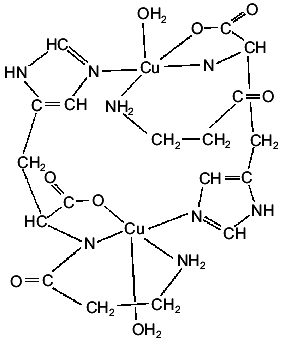
Fig 1. Carnosine-Copper chelate
|
Vaccinations & Mercury
In the context of vaccination chelation with carnosine may be crucial, as it removes organic mercury (thiomersal or thimerosal) from a child. Organic mercury is present in most vaccines as an antimicrobic preservative, although it since the 1930´s has been recognised as a toxic substance affecting the central nervous system. In my opinion every vaccinated child and adult should take carnosine as a precaution in order to remove thiomersal from the body as soon as possible.
|
Fig 2. Carnosine-Zinc chelate
|
EDTA Chelation Therapy & Atherosclerosis
Chelation therapy became a popular "alternative" treatment after EDTA was found effective in chelating and removing toxic metals from the blood, and some scientists postulated that hardened arteries could be softened if the calcium in their walls was removed. The first indication that EDTA treatment might benefit patients with arteriosclerosis came from Clarke, Clarke, and Mosher, who, in 1956, reported that patients with occlusive peripheral vascular disease said they felt better after treatment with EDTA.
Personal Experience
Some elderly people, who on a regular basis take EDTA chelation therapy on the Costa del Sol, Spain, and they claim it has kept them alive and healthy well into their golden years. The EDTA therapy is, however, expensive and cumbersome, as it is given intravenously as a slow infusion at a clinic.
In Summary
Carnosine, as a dietary supplement, seems to have all the same chelating properties as EDTA, and it offers a possibility for an inexpensive oral chelation therapy. Carnosine has an ability to chelate prooxidative metals, such as copper, zinc and toxic heavy metals (lead, mercury, cadmium, nickel).
Download Carnosine Product Brochure ( ) )
|