|
|
Alzheimer's & Senile Dementia
|
Alzheimer's, Senile Dementia & L-Carnosine Therapy
In experiments, treatment with carnosine was found to reduce or completely prevent cell damage caused by beta amyloid, the substance found in the brain of Alzheimer's disease patients. Beta amyloid can interact with certain RAGE receptors causing damage to the nerves and arteries of the brain. Carnosine blocks and inactivates beta amyloid, so it protects neural tissues against dementia.
Moreover, carnosine protects the brain cells by fighting the highly toxic alpha, beta-unsaturated aldehyde acrolein which is formed during the peroxidation of polyunsaturated lipids, raising the possibility that it functions as a 'toxicological second messenger' during oxidative cell injury (Burcham et al. 2000).
|
|
Recent research also confirms that the toxic unsaturated aldehyde crotonaldehyde (CA) contributes to carbonylation resulting in protein damage during lipid peroxidation (Fontaine et al 2002). As carnosine combats all aldehydes, it offers another explanation for its benefits in prevention of Alzheimer´s disease and other conditions with oxidative stress.
Metal chelation by carnosine may prevent and slow down Alzheimers.
Some laboratory studies have reported excessive amounts of metal ions such as zinc, copper in Alzheimer´s brain. Such ions may possibly change the chemical architecture of normal beta amyloid, making it more harmful. A mildly acidic environment appears to be important in the process that binds these metals to beta amyloid. Experts observe that such conditions (acidic environment and higher levels of zinc and copper) commonly occur as part of the inflammatory response to local injury. Carnosine has the unique ability to chelate copper, zinc and other metals, and to remove them from the body, as explained above in the section Metal Chelation. This may be an important function of carnosine in preventing and slowing down Alzheimer´s and other degenerative brain disorders.
Other Information
- Carnosine may prevent proteasomal decline in Alzheimer's disease More...
-
MEDLINE data base includes at this writing nine documents on the relationship between carnosine and Alzheimer´s. If you want to read them, search for "carnosine; Alzheimer", and click "go".
- More about Carnosine
|
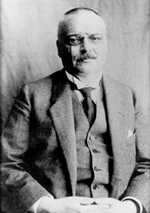
Dr Alois Alzheimer
(1864-1915)
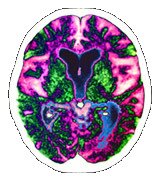
Brain scan of an Alzheimer´s
patient. The pink area represents destroyed brain
tissue.
|
|
|
|
| Carnosine, L-Carnosnie |
|
|
|
| Omax3 with 1500mg of Omega-3s per serving |
 |
|
|
|










